

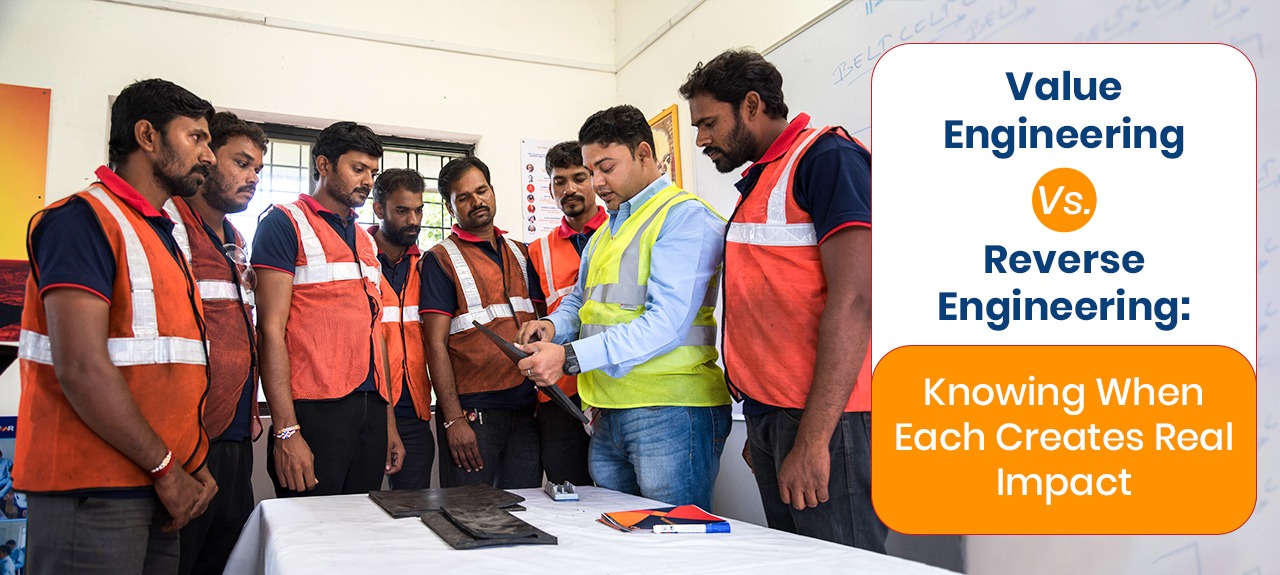
Executive Summary
Value engineering and reverse engineering are frequently grouped together as cost-control mechanisms. In practice, they serve fundamentally different strategic purposes at different stages of an asset’s lifecycle. Value engineering shapes outcomes before inefficiencies are embedded into design and procurement commitments. Reverse engineering extracts intelligence from assets that are already built, often operating under live and complex conditions. In airport and infrastructure programs, the distinction is not academic, it directly affects capital efficiency, lifecycle economics, risk exposure and operational resilience.
This perspective emerges from delivery environments where design intent must continuously align with operational reality. The question is not whether to reduce cost. The real question is whether we are reducing uncertainty and at which stage.
In aviation infrastructure, design decisions are rarely reversible. Geometry, system architecture, phasing logic and integration strategies establish cost and performance patterns that can persist for decades. When value engineering and reverse engineering are treated as late-stage corrective tools, they often become reactive exercises that compromise performance rather than enhance it.
Mature organisations recognise that both methods are decision frameworks. They are aligned with capital planning cycles, asset renewal strategies and operational continuity requirements. The difference between them lies in timing, data maturity and the nature of the uncertainty being addressed. Value engineering optimises intent before construction. Reverse engineering decodes operational truth after delivery.
Value engineering delivers the greatest impact before procurement commitments are locked in. At the concept and schematic stages, alternatives can still influence core parameters such as passenger flow modelling, baggage system routing, energy plant sizing, structural configuration and phasing logic in live operational environments.
The discipline begins not with specification but with function. Instead of asking whether a predefined configuration is cost-efficient, the discussion examines whether the configuration itself is necessary to achieve the intended outcome. This reframing often reveals opportunities to simplify system architecture, eliminate embedded inefficiencies and align capital allocation with operational priorities rather than historic design habits.
In live airports, value frequently lies not in marginal material substitution but in constructability sequencing that preserves operational continuity. A design that reduces disruption risk during construction can generate far greater long-term value than incremental savings in procurement cost. Properly executed, value engineering does not produce a cheaper design. It produces a design that allocates capital where it creates measurable operational advantage and resilience.
Reverse engineering becomes critical when the asset already exists and documentation no longer reflects operational reality. Airports that have expanded in multiple phases often inherit systems that evolved through different contractors, technologies and standards. Performance drift, undocumented modifications, and operational workarounds introduced by frontline teams create layers of complexity that are rarely visible in original drawings.
In these environments, reverse engineering reconstructs three essential layers of intelligence: the actual system configuration, the hidden interdependencies between disciplines and the informal adaptations that keep operations running. This understanding becomes the foundation for asset renewal, capacity enhancement, compliance upgrades and digital integration initiatives.
Unlike value engineering, which questions what should be built, reverse engineering asks what truly exists. It is a core input to structured project risk management because it exposes assumptions that may no longer hold under current load, regulatory requirements, or operational patterns.
The financial and operational returns of both approaches are maximised when they are applied at the appropriate phase. During concept and schematic design, value engineering enhances capital efficiency and performance optimisation. Before tender, it clarifies procurement scope and reduces downstream risk exposure. In brownfield expansion planning, reverse engineering ensures scope accuracy and realistic phasing. During asset modernisation in live operations, it protects continuity and compliance.
Misalignment produces predictable consequences. Late-stage value engineering often devolves into scope reduction that erodes functionality. Early reverse engineering without a defined strategic objective can become a documentation exercise disconnected from decision-making.
Airports operate under regulatory regimes where safety, capacity and passenger experience are inseparable. Every cost decision must therefore pass through a structured aviation risk filter. In this environment, the objective is not expenditure reduction but controlled risk.
Value engineering contributes by eliminating overdesign that complicates maintenance and increases failure points, while simplifying system architecture in ways that improve fault response time. Reverse engineering contributes by identifying undocumented modifications that compromise redundancy and validating actual load conditions against regulatory assumptions. Both methods serve resilience when applied with discipline.
The effectiveness of either approach depends less on methodology and more on orchestration. Structural systems, MEP networks, airside infrastructure and digital platforms must be evaluated within a shared performance framework. High-performing multidisciplinary teams establish a single evaluation environment where cost planners, designers, operators and maintenance specialists review alternatives against common metrics.
Without this integration, a capital saving in one discipline frequently creates an operational cost in another. In aviation programs, this misalignment directly influences gate availability, energy consumption, asset reliability and passenger processing time. True impact arises when engineering evaluation is embedded within operational accountability.
Reverse engineering in operational assets often generates insights that inform future value engineering. Live systems reveal how passengers actually behave, how assets degrade under real environmental conditions and where maintainability determines uptime more than design theory.
Organisations that institutionalise this feedback loop progressively reduce uncertainty in future capital programs. Assumptions become grounded in operational evidence rather than theoretical demand projections. Over time, predictability improves because design decisions are informed by lived performance.
The conversation around these methodologies is frequently framed around capital expenditure. However, for airport operators, the larger financial impact lies in lifecycle cost and revenue continuity.
Value engineering influences energy demand profiles, maintenance accessibility and redundancy strategies that determine long-term reliability. Reverse engineering influences the accuracy of asset condition assessments, phasing strategies that protect aeronautical and non-aeronautical revenue and compliance upgrades executed without shutdown penalties.
At this level, infrastructure cost advisory moves beyond estimation. It becomes a commercial performance instrument aligned with business continuity.
Methodologies do not create value in isolation. Delivery experience determines impact. Teams that have operated large airports understand the financial implications of disrupting a baggage hall during peak season or modifying airside systems under regulatory oversight.
An integrated engineering services provider with sustained exposure to complex aviation environments brings continuity between capital delivery and asset management. Design decisions are tested against real operational constraints. Project risk management is embedded within engineering review. Capital programs are evaluated not only for cost efficiency but for operational consequence.
This capability transforms value engineering and reverse engineering from technical exercises into strategic business decisions.
The relevant question for senior decision-makers is not which method is superior. The appropriate question is which uncertainty must be addressed at the current stage of the asset lifecycle.
Value engineering shapes the future before construction embeds inefficiency. Reverse engineering reveals the operational truth of what already exists. Organisations that institutionalise both approaches create a closed learning loop between design, delivery and operations.
In aviation infrastructure, this loop determines whether expansion programs enhance capacity seamlessly or introduce years of hidden inefficiency.
“In infrastructure, the question is never whether to reduce cost. The real question is whether we are reducing uncertainty. Value engineering shapes the future before it is built. Reverse engineering reveals the truth of what already exists. Impact comes from knowing which question to ask and when.” - Roy Sebastian, CEO, GEMS
For strategic value engineering, structured reverse engineering programs and integrated infrastructure cost advisory across complex aviation environments:
Rohitkumar.Singh@gmrgroup.in | +91 97171 99753