

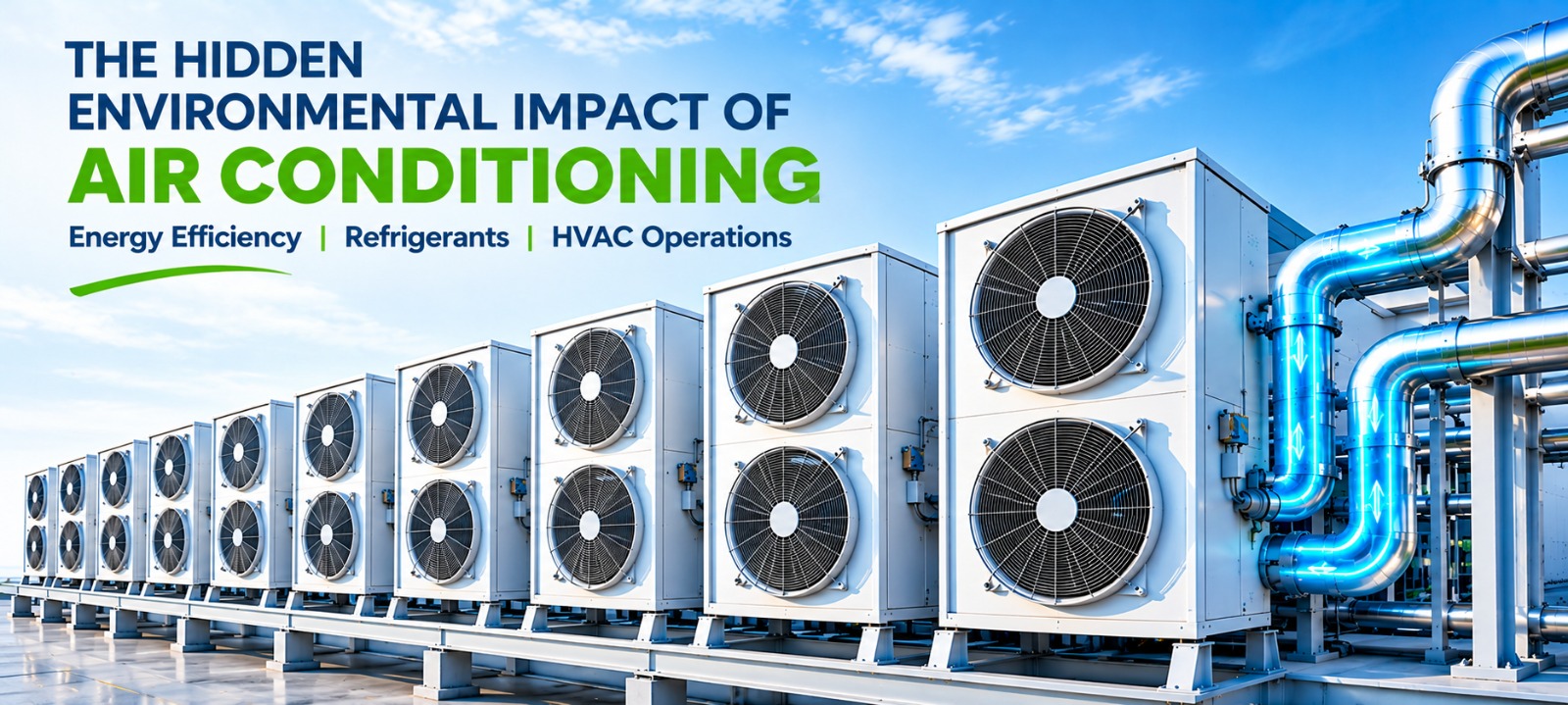
Walk into any airport terminal on a hot afternoon and you probably won’t think about the air conditioning. That’s the point. From check-in halls and departure lounges to baggage areas and back offices, Heating, Ventilation and Air Conditioning (HVAC) systems maintain comfortable conditions for passengers, staff and everyone who keeps the airport running.
But that comfort comes with an environmental cost. Airport HVAC systems often operate around the clock, responding to changing passenger volumes, outdoor temperatures and ventilation requirements. This makes energy consumption, refrigerant management and maintenance important considerations for airport operators, rather than peripheral issues.
As airports grow, the focus is increasingly shifting towards energy-efficient HVAC systems, responsible refrigerant management and sustainable HVAC operations. The objective is not simply to keep terminals cool, but to do so with less wasted energy, better-performing equipment and a smaller environmental footprint.
Airport terminals are not ordinary buildings. They have vast enclosed spaces, continuous passenger movement and occupancy levels that can change sharply within a matter of hours. Each zone has different requirements and those requirements change throughout the day.
HVAC systems carry much of that load. When equipment is inefficient, temperature settings are poorly optimised, airflow is inadequately managed or systems operate at full output regardless of demand, energy consumption rises unnecessarily.
Most of the environmental impact of air conditioning comes down to two key areas:
Energy consumption: Chillers, Air Handling Units (AHUs), pumps and cooling towers consume significant amounts of electricity. Depending on how that electricity is generated, this contributes to indirect carbon emissions.
Refrigerant emissions: Refrigerants can contribute to global warming if they leak during operation, servicing or disposal. The extent of their environmental impact depends largely on the type of refrigerant used.
Managing both effectively is central to building more sustainable airport infrastructure and improving long-term operational efficiency.
Because airport terminals operate for long hours, even relatively small improvements in HVAC performance can add up. A modest saving every hour can translate into a meaningful reduction in annual energy consumption.
Energy-efficient HVAC systems maintain the required indoor conditions without consuming more power than necessary. Their performance depends on four key factors: equipment selection, system design, intelligent controls and effective maintenance.
Here is where airport operators can make a real difference:
In large airport air-conditioning networks, chillers are among the biggest energy consumers. Operating them at appropriate loads, keeping heat exchangers clean and continuously monitoring cooling performance can significantly improve overall system efficiency.
Regular inspection of pumps, cooling towers and associated equipment is equally important. Problems identified early can be corrected before they affect system performance and increase energy consumption.
A busy check-in hall in the early morning and a quiet administrative wing at the same time do not need the same level of cooling. Neither do retail spaces and departure lounges, where occupancy fluctuates with flight schedules.
A Building Management System (BMS) can monitor indoor conditions and adjust HVAC operations accordingly. Through appropriate temperature settings, scheduling and airflow management, terminals can reduce unnecessary cooling without compromising passenger comfort.
AHUs circulate, filter and condition indoor air. When filters become clogged, ducts are poorly maintained or fans lose efficiency, airflow deteriorates and the system must work harder to maintain the required conditions.
Replacing filters on schedule, inspecting ducts and monitoring fan performance help maintain efficient ventilation while supporting indoor air quality.
Effective energy management starts with understanding, on an ongoing basis, where electricity is being consumed.
Energy monitoring supported by BMS, automation and control systems enables airport operators to identify unusual consumption patterns, track equipment performance and make decisions based on operational data rather than assumptions.
Together, these measures make airport HVAC systems more energy-efficient and support the airport’s broader sustainability objectives.
Electricity consumption tends to receive most of the attention in discussions about cooling. Refrigerants deserve equal consideration.
Refrigerants transfer heat through cooling systems and are therefore essential to HVAC operation. However, some refrigerants have a high Global Warming Potential (GWP) and when released through leakage, servicing or improper handling, they can make a significant contribution to climate impact.
Effective refrigerant management goes beyond selecting the right equipment. It requires a structured approach covering the complete equipment lifecycle, from installation and operation to servicing and eventual decommissioning.
In practice, this means:
Done well, refrigerant management helps airports meet environmental requirements while improving the long-term reliability of HVAC infrastructure.
Advanced equipment is only half the story. How an HVAC system is operated and maintained throughout its lifecycle can be just as important to its overall efficiency.
In a large airport, HVAC does not operate in isolation. It is closely connected with electrical infrastructure, ventilation networks, water systems and other mechanical equipment. When performance deteriorates, the impact can be seen in energy consumption, indoor comfort and day-to-day airport operations.
A structured approach to HVAC operations and maintenance addresses this through:
Planned Preventive Maintenance: Scheduled inspection and servicing of chillers, pumps, AHUs, cooling towers, filters and associated components to maintain consistent performance.
Performance Monitoring: Tracking key parameters such as temperature, pressure, airflow and energy consumption to identify deviations from normal operating conditions.
BMS Integration: Connecting HVAC equipment to the BMS to provide greater visibility of equipment status, operating schedules and indoor conditions.
Condition-Based Maintenance: Using equipment and performance data to identify early signs of deterioration, allowing teams to intervene before minor issues develop into major failures.
Operational Coordination: Scheduling maintenance activities around airport operations to minimise disruption, particularly during peak passenger movements and busy flight schedules.
This is why HVAC maintenance sits at the centre of broader Airport Operations and Maintenance services, rather than on the sidelines.
HVAC systems do not operate in a vacuum. Their performance is closely linked to the overall energy requirements of the terminal.
An integrated approach to airport energy management gives operators greater visibility into how individual infrastructure systems contribute to total electricity consumption. Energy audits, equipment monitoring and performance assessments can then identify opportunities for improvement.
For example, HVAC operating schedules can be aligned with terminal occupancy, while BMS monitoring can identify equipment that continues to operate when demand has reduced.
Regular energy audits can also uncover inefficient equipment, operational gaps and opportunities for upgrades.
Supported by strong engineering services and disciplined airport infrastructure maintenance, these measures collectively contribute to more sustainable airport operations.
As airports expand, sustainability needs to be embedded in the way terminals are planned, developed, operated and maintained, rather than added as an afterthought.
Moving towards sustainable HVAC systems requires a combination of efficient equipment, intelligent controls, responsible refrigerant management and disciplined maintenance. No single measure can deliver the required outcome on its own.
Airport operators can strengthen their approach by:
The result is a better balance between passenger comfort, operational reliability and environmental responsibility.
GMR Engineering & Management Services (GEMS) views airport infrastructure as one interconnected system, where engineering performance, maintenance discipline and operational continuity depend on each other.
HVAC is an important part of that ecosystem. Its efficiency depends not only on the technology installed, but also on how effectively it is monitored, operated and maintained throughout its lifecycle.
Through its capabilities in airport infrastructure maintenance and development, engineering services and Airport Operations and Maintenance, GEMS supports the day-to-day infrastructure requirements of modern airports.
As airports move towards smarter and more sustainable infrastructure, efficient HVAC operations, responsible refrigerant management and data-led energy monitoring will become increasingly important.
Ultimately, airport sustainability will not be judged only by what airports build, but by how efficiently and responsibly they operate and maintain it.
For airport engineering, infrastructure maintenance and Airport Operations and Maintenance services, get in touch with GMR GEMS.
“The efficiency of an airport’s HVAC infrastructure goes beyond maintaining indoor comfort. It requires a consistent focus on energy performance, preventive maintenance and responsible resource management. By combining engineering expertise with effective monitoring and operational discipline, airports can build more reliable and sustainable infrastructure.”
— Roy Sebastian, CEO, GEMS
For airport HVAC operations and maintenance, energy management, airport engineering and infrastructure maintenance services, reach out to:
Email: Rohitkumar.Singh@gmrgroup.in
Phone: +91 97171 99753