

Executive Summary
Many airports still treat fire protection as a collection of installed devices and vehicles. This is a fragile assumption. True resilience requires systems thinking, where equipment, detection, human response, governance, maintenance and continuous learning operate as one integrated capability.
Installation is only the first step. Without integration, testing, people readiness and governance, fire safety systems will not deliver the outcomes airports and travelers expect. Global standards are clear on this point, yet practice continues to lag in many locations.
Modern airports rely on increasingly complex fire protection assets, including fixed suppression systems, early detection technologies, fuel-system protections, specialized firefighting vehicles and personal protective equipment. Regulations and advisory material define minimum equipment requirements, but compliance with hardware checklists does not guarantee life safety or asset protection when minutes matter.
Two factors explain this gap.
First, design intent is often lost between procurement and operation. A compliant vehicle or sprinkler system may not align with how a terminal is actually used, how passengers move or how fuel-handling activities are conducted.
Second, systems degrade over time. Sensors drift, foam concentrates age, valves seize and response teams change. Without sustained attention, installed safety layers become brittle.
Global aviation standards consistently treat fire safety as both a technical and operational discipline. Requirements for rescue and firefighting services are linked to airport category, aircraft types and operational risk. Equally important are expectations around training, live drills and coordination with local and specialist emergency services.
The intent is unambiguous: airports must manage people, processes and equipment as one system, not as isolated silos.
Fire protection must reflect actual risk. A maintenance hangar with hot-work exposure requires fundamentally different strategies than a domestic departure concourse. Standards encourage risk-based design, not one-size-fits-all solutions.
Early detection has value only if it initiates the right response. Frequent false alarms create desensitization and delayed reactions during real events. Detection strategies must consider smoke movement, HVAC behavior and egress patterns.
Suppression systems and foam supplies require disciplined testing, rotation and replenishment. Agents have shelf lives and performance limits. Lifecycle logistics must be embedded in procurement decisions, not treated as an afterthought.
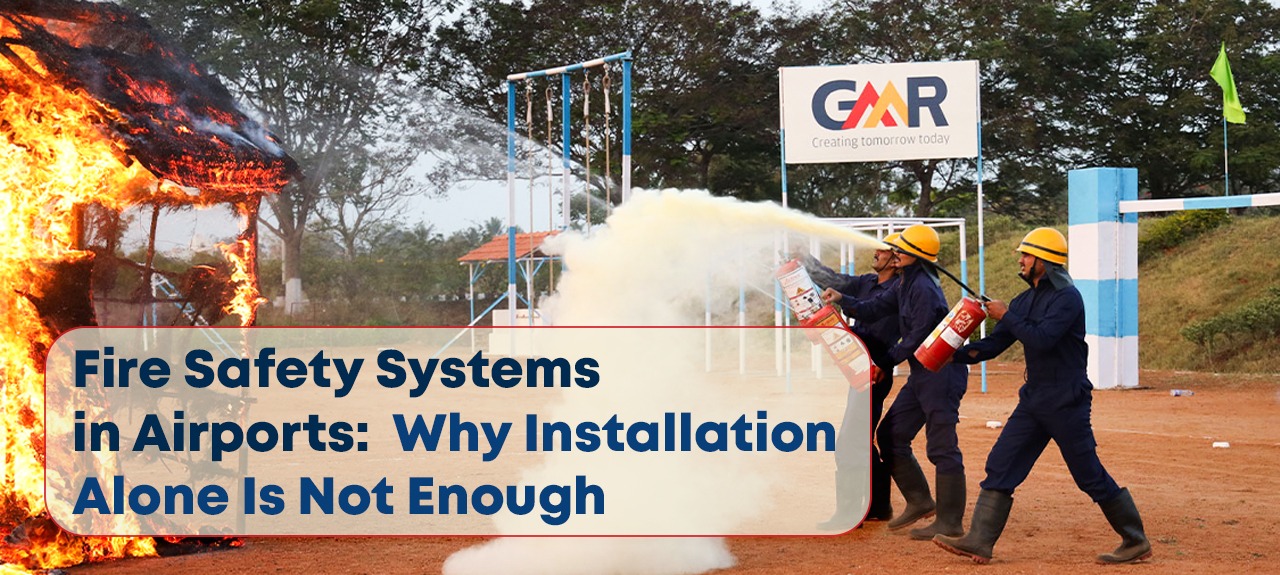
Live, pressure-fed fuel fire drills and scenario-based exercises are essential. Training must include terminal layouts, communication protocols and coordinated multi-agency response. Exercises reveal human and system failure points that plans alone never expose.
Maintenance logs alone do not guarantee reliability. Condition-based testing, performance verification and independent audits significantly reduce the risk of failure during emergencies.
Terminal evacuations, apron fuel fires and cargo incidents demand synchronized action across airport operations, firefighting services, airlines, handlers, police and municipal responders. Clear command and control structures prevent confusion and dangerous delays.
After-action reviews must drive tangible change, in procedures, layouts, procurement and training. Historical incidents repeatedly expose the same failure patterns when lessons are not institutionalized, particularly around compartmentation, combustible materials and contractor hot-work controls.
Historical airport fire reviews show that catastrophic outcomes are rarely caused by a single device failure. More often, they result from multiple small breakdowns combining into systemic failure.
In one well-documented terminal fire, welding above a false ceiling and combustible construction materials created a rapidly spreading ceiling fire. Installed systems were overwhelmed and evacuation became complex. The immediate cause was hot work, but root causes included poor contractor oversight, material selection and untested smoke-control assumptions.
Installation alone did not provide resilience.
Buy to mission. Require suppliers to demonstrate performance in your actual terminal geometry and operational scenarios.
Track consumables, certifications and condition indicators. Use third-party audits for critical systems.
Conduct full-scale drills and targeted tabletop exercises on a planned cadence, involving airlines, handlers and local authorities.
Keep it concise, visual and accessible at all control points. Tie roles directly to alarm-stage checklists.
Track agent levels, valve states and vehicle readiness in real time for daily operational visibility.
Apply permit systems, fire watches and inspections for any activity introducing ignition risk.
Require after-action reviews and enforce change for identified systemic weaknesses.
Shift measurement from installed counts to outcome-focused indicators, such as:
These metrics reflect resilience, not just presence.
Installing fire safety systems is necessary, but never sufficient. Airport fire safety must be treated as a living capability integrating design, operations, people, logistics and governance. Airports that invest in integration, realistic drills, lifecycle maintenance and continuous learning close the gap between equipment and outcome.
Standards provide the platform. Operational discipline delivers resilience.
“Technical compliance without organizational readiness creates brittle protection. Fire systems must be supported by trained staff, coordinated emergency procedures and interoperable communications across airlines, ground handlers and emergency services. Investment in drills, human factors and decision protocols converts installed capacity into real resilience.”
- Roy Sebastian, CEO, GEMS
For end-to-end fire safety system assessments, resilience planning and operational assurance programs: 📧 Rohitkumar.Singh@gmrgroup.in | 📞 +91 97171 99753