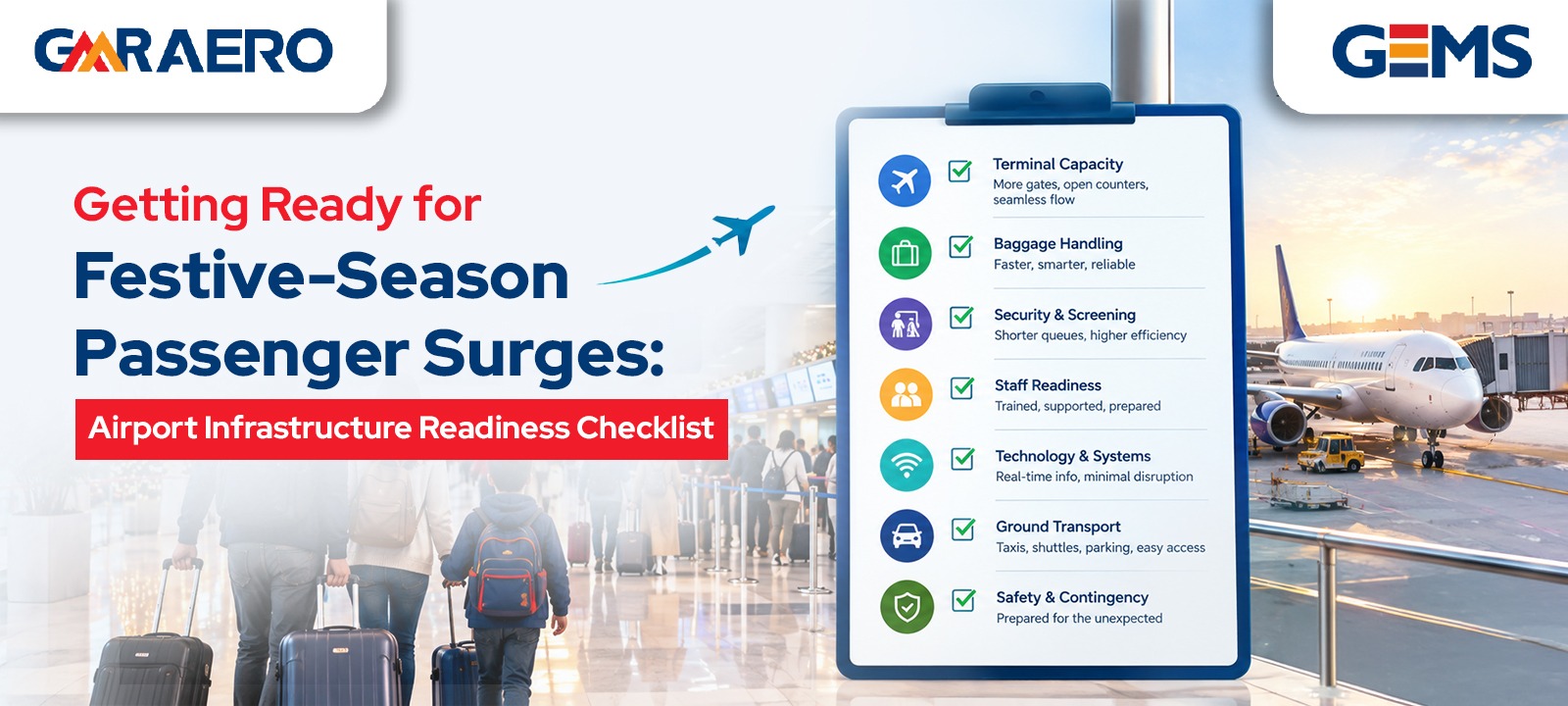
Every year, the festive season places airports under a level of pressure that few other periods can match. From Dussehra and Durga Puja through Diwali and Chhath, followed by the Christmas and New Year travel period, demand is compressed into a few intense weeks. Terminals, airside systems, utilities and operational teams are all pushed towards their limits at the same time.
Yet festive peaks are among the most predictable events in airport operations. The dates are known well in advance, airline schedules are filed early, and previous seasons provide a clear record of where pressure points emerged. Most peak-season disruptions are therefore not caused by the surge itself, but by readiness gaps that remain unnoticed until demand exposes them.
At GMR GEMS, airport festive-season readiness is viewed not as a last-minute operational scramble, but as a structured engineering and maintenance programme that begins months before the peak travel window.
An airport functions as a tightly interconnected system. Check-in, security screening, baggage handling, passenger boarding bridges, HVAC, power, water, lighting and IT platforms all depend on one another. On a normal day, spare capacity across these systems absorbs minor faults with little or no passenger impact.
During festive peaks, that buffer narrows considerably. A single escalator outage, a stalled baggage belt or inadequate cooling in a crowded departure hall can quickly cascade into queues, delays and passenger dissatisfaction.
The challenge is intensified by the way festive demand behaves. Pressure is not distributed evenly throughout the day; it is concentrated in short, intense windows when several departures overlap. Festive travel also brings a different passenger mix, with more families, first-time travellers, elderly passengers and higher checked-baggage volumes. Each factor places additional demand on infrastructure and frontline teams.
Effective passenger surge management at an airport therefore depends less on the overall size of the terminal and more on how thoroughly its infrastructure and operating arrangements have been prepared for peak-hour stress.
A structured pre-peak readiness assessment provides a clear view of how airport infrastructure is likely to perform under festive load. Such assessments frequently uncover risks that remain hidden during routine operations.
One common finding is deferred maintenance on high-use assets. Escalators, travelators, lifts and baggage conveyors may perform adequately at normal volumes while carrying minor defects that can become failure points when utilisation rises sharply.
Spare-parts readiness is another recurring gap. Critical components such as conveyor motors, belts, sensors and HVAC parts may have long procurement lead times. Without early identification and stocking, a single component failure can keep an essential system out of service during the busiest days of the year.
Readiness assessments may also identify capacity mismatches within building systems. HVAC performance may be adequate at average occupancy but insufficient for crowded departure halls at peak hours. Water supply, washroom facilities, pumping systems and electrical infrastructure can face similar strain under sustained high footfall.
Finally, readiness reviews often expose coordination gaps: rosters that do not reflect peak-hour demand, vendor response arrangements that have not been tested under pressure, and escalation processes that depend on informal communication rather than a clearly defined command structure.
Readiness is most effective when it follows a defined timeline. A practical cycle begins around 90 days before the peak period: assess at T-90, complete priority maintenance and procurement by T-60, test critical systems by T-30, and finalise rosters while freezing non-essential works by T-7.
Within this cycle, the following areas form the core of airport infrastructure readiness:
Service and test check-in counters, kiosks, bag-drop units and security screening equipment, with backup units identified. Maintain escalators, travelators and lifts, with technicians available during peak hours.
Load-test conveyors, sorters and reclaim belts at expected peak throughput. Stock critical spares on site and rehearse manual fallback arrangements.
Complete runway, taxiway and apron inspections; close airfield ground-lighting faults; service passenger boarding bridges; and prepare remote-stand plans for overflow demand.
Verify HVAC performance against peak occupancy. Test DG sets, UPS and power-changeover systems under load, and check water supply, pumping and sewage systems for higher usage.
Test flight information displays, common-use check-in platforms and digital entry systems for peak throughput. Apply a change freeze to critical systems during the festive window.
Plan kerbside traffic, parking and pick-up zones in coordination with local authorities, and audit wayfinding signage for clarity and visibility.
Finalise peak-period rosters early, confirm maintenance-vendor standby arrangements and response times, and establish a shared escalation matrix across airlines, security agencies and ground handlers.
Preparation ensures that infrastructure is ready. Surge management determines how effectively it performs once demand arrives.
The most important shift is to plan around peak banks rather than daily totals. A terminal may comfortably handle a busy day overall yet struggle during a short window when several departures overlap. Mapping the hourly departure profile allows staffing, screening lanes and maintenance coverage to be aligned with actual demand.
Real-time visibility is equally important. Queue lengths at entry gates, security checkpoints and boarding areas are early indicators of stress. Live monitoring enables duty managers to open additional capacity or redeploy teams before congestion escalates.
Maintenance response also changes during the peak. Technical teams positioned close to critical assets, with spares pre-staged, can resolve minor faults in minutes rather than hours, often before passengers become aware of the issue.
A short daily readiness huddle involving operations, maintenance, security and airline partners helps ensure that issues from the previous day are resolved before the next peak begins.
The cost of an unprepared peak is rarely limited to the immediate incident. A failed baggage belt during a festive evening bank can affect multiple flights, ground-handling schedules, passenger connections and the airport’s reputation at the same time.
Unplanned breakdowns during high-demand periods also tend to be more expensive to resolve. Emergency procurement, overtime and accelerated repairs typically cost more than the same intervention undertaken through planned maintenance.
Beyond avoiding disruption, structured festive readiness contributes to:
“Festive peaks are not surprises; they arrive on the same calendar every year. What separates a smooth peak from a difficult one is how early an airport starts preparing and how clearly it understands the condition of its infrastructure. Readiness is built in the months before the rush through maintenance, testing and coordination, not in the final week.
At GMR GEMS, we believe the most resilient airports are those that treat every peak season as a planned operation, and every season thereafter as an opportunity to become better prepared.”
— Roy Sebastian, CEO, GEMS
At GMR GEMS, festive-season readiness is not treated as a once-a-year checklist, but as part of a broader approach to intelligent airport asset management.
Data gathered during each peak, including asset performance, failure patterns, queue behaviour and response times, can be used to strengthen maintenance planning for the next cycle. Over time, this moves airports from reactive preparation towards predictive readiness.
This transformation is supported by:
The result is infrastructure that does not merely withstand the festive surge, but is prepared for it by design.
Festive-season passenger surges are among the most demanding and most predictable events in the airport calendar. Although they may appear to be an operational challenge, their outcome is largely determined by engineering and maintenance decisions made months earlier.
Structured readiness directly influences:
For airports seeking to deliver seamless travel during periods of peak demand, festive readiness is no longer a seasonal task. It is a strategic discipline.
The airports that perform best during the festive rush will not necessarily be those with the greatest capacity, but those that prepare their infrastructure most intelligently.
For airport infrastructure readiness assessments, maintenance planning and peak-season operational support, please contact:
Email: Rohitkumar.Singh@gmrgroup.in
Phone: +91 97171 99753