

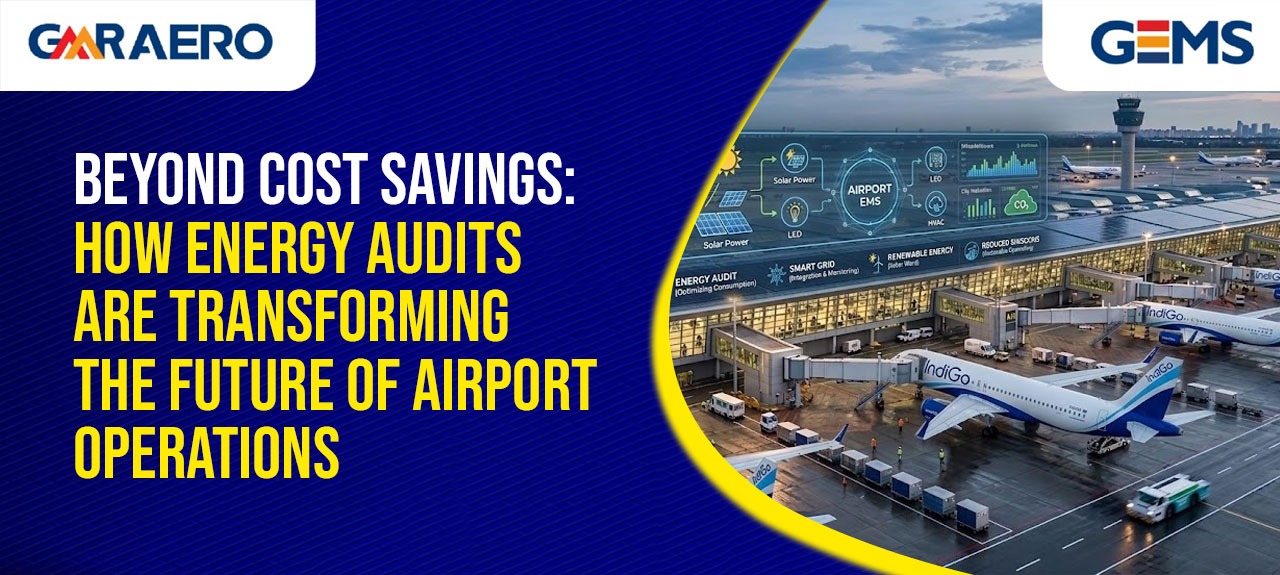
Building Smarter, Greener Airports
Every airport today faces a common challenge: reducing operating costs while meeting increasingly ambitious sustainability expectations without compromising operational resilience, passenger experience or business continuity. Energy management now sits at the centre of this challenge. Airports operate around the clock, serving millions of passengers while coordinating thousands of interdependent systems. Yet many continue to consume significantly more energy than necessary. The gap between current consumption and optimum performance is where a rigorous energy audit creates measurable value.
Airports are among the most energy-intensive facilities on the planet, measured by consumption per square metre. The aviation sector accounts for roughly 2–3% of global CO₂ emissions; airports themselves, independent of aircraft operations, contribute a substantial and frequently overlooked share of that footprint. Lighting, HVAC, escalators, baggage handling systems, ground support equipment, IT infrastructure and water treatment facilities all draw continuously on electricity and thermal energy, around the clock, every day of the year.
What makes this both a challenge and a genuine opportunity is that a large portion of this consumption is avoidable. At GEMS, we have seen first-hand how data-driven energy management, grounded in structured auditing, can transform an airport's operational and financial performance, while advancing its sustainability commitments in ways that satisfy regulators, investors and passengers alike.
An energy audit is not a checklist exercise or a facilities walk-through. In the context of an airport, it is a systematic, multi-layered investigation into every energy-consuming system, process and behaviour across the entire asset ecosystem. Its output is not simply a list of problems, it is a complete energy map: a precise picture of where energy enters the system, where it is used productively and where it is lost.
A comprehensive airport energy audit typically covers the following domains:
HVAC chillers, air handling units, cooling towers and district cooling networks including how they are coordinated. Are zones being over-cooled during off-peak hours? Are heating and cooling systems inadvertently working against each other?
Distribution switchgear, transformer losses, power factor correction, harmonic distortion and load profiling. Are certain feeders carrying unbalanced loads? Are transformers running at chronically low utilisation?
Terminal lighting, apron floodlighting, runway and taxiway lights, car park lighting and service road lighting. What proportion still relies on legacy technology? Are controls dynamic or static?
Motor efficiency, start-stop cycles, standby power consumption and drive optimisation. BHS motors running continuously on empty belts represent a significant and typically untracked cost.
Pumping networks, sewage and water treatment, compressed air and steam systems. Leaks, oversized pumps and inefficient scheduling all contribute silently to waste.
Data centre cooling, server room energy use and whether BMS platforms are actively managed or simply collecting data without driving intervention.
Shift schedules, manual overrides, reactive versus preventive maintenance cycles and departmental energy accountability structures all of which can negate the gains of technical upgrades if left unaddressed.
Through years of airport operations experience, GEMS has identified six categories of energy loss that recur across airports of varying scales and ages yet remain chronically under addressed.
Terminals experience dramatic occupancy fluctuations throughout the day, yet HVAC systems in most airports are designed and operated for peak load conditions and never adjusted downward. A terminal at 3 AM with minimal foot traffic continues to be conditioned as though it were peak afternoon. This single inefficiency can account for 15–20% of avoidable HVAC energy consumption in a medium-to-large airport.
Many airports have partially retrofitted to LED but have not invested in the control intelligence that makes LED genuinely transformative. Without occupancy sensing, daylight harvesting and dimming capability, the energy savings of the technology are only partially realised. Airfield and apron lighting often running on fixed schedules rather than operational demand compounds the loss during low-activity periods.
BHS motors are engineered to handle peak throughput, but airports rarely see simultaneous peak activity across all belts. Without variable frequency drives (VFDs) and intelligent belt sequencing, motors spin at full speed even when carrying no baggage. This standby draw is invisible in operational reporting but highly visible in the monthly electricity bill.
Poor power factor the efficiency with which electrical power is converted into useful work adds a hidden cost to every unit of electricity consumed. In large airport electrical networks, uncorrected power factor results in significant reactive power charges from utilities, as well as increased cable and transformer losses. Without dedicated power quality monitoring, this drain goes entirely undetected.
Many airports have invested in BMS platforms yet those systems operate in isolation. HVAC data here, lighting controls there, power monitoring somewhere else. Without integration, there is no unified operational intelligence: anomalies persist undetected, optimisation opportunities go unrealised and decisions are made reactively rather than proactively.
The modern airport need not be a passive consumer of energy. With the right technology infrastructure, it becomes an active, intelligent energy system one that monitors, predicts and optimises consumption in real time across every operational domain.
Granular, real-time visibility into consumption at the sub-system level. Rather than receiving a monthly utility bill and reacting to it, operations teams can identify anomalies within hours of their occurrence and act before they become costly.
Predictive energy management systems that learn from historical operational patterns and proactively adjust HVAC, lighting and other loads based on forecast occupancy, weather conditions and flight schedules anticipating demand rather than responding to it.
Energy engineers can model the impact of proposed changes before a single component is touched de-risking capital decisions, accelerating the approval cycle for energy investments and eliminating the guesswork from upgrade planning.
A unified view of energy performance tied directly to operational KPIs that breaks down departmental silos and gives every stakeholder, from facilities management to finance to sustainability, the same picture of the asset's energy health.
The business case for airport energy management extends well beyond operational cost reduction. External pressures are accelerating the urgency for airports to decarbonise and to demonstrate that commitment with verified, third-party data.
The ACI programme has seen rapid adoption globally, with Level 3 (Optimisation) and Level 3+ (Neutrality) now widely regarded as the industry standard for credible sustainability commitment. Energy audit data is the foundational input for achieving and maintaining these levels.
TCFD, GRI and national environmental compliance requirements increasingly require airports to quantify, report and reduce Scope 1 and Scope 2 emissions. Without rigorous, independently verifiable energy data, these obligations cannot be met with confidence.
LEED, IGBC (widely applied in India) and BREEAM are increasingly required for new terminal developments, with structured energy management as a prerequisite, not an optional enhancement. India's airports are at a particular inflection point. With the Airports Authority of India and major private operators expanding capacity at unprecedented scale, the energy infrastructure choices made today will define these airports' sustainability trajectories for decades. The cost of getting those decisions wrong, in stranded capital, retrofit expense, and regulatory exposure, far exceeds the cost of rigorous upfront planning.
At GEMS, energy management is not a peripheral or compliance-driven activity. It is embedded into the core of how we design, operate and continuously improve airport and commercial building infrastructure. Our approach is built on four integrated pillars:
Comprehensive sub-metering, power quality monitoring and real-time dashboards that deliver complete operational visibility at every level of the asset hierarchy, from the terminal-wide to the individual circuit.
Structured energy audits combined with advanced data analytics to identify inefficiencies, benchmark performance against international standards and prioritise intervention opportunities by their financial and carbon impact.
Implementation of targeted engineering solutions from VFDs and smart lighting controls to integrated BMS platforms and renewable energy integration that convert identified opportunities into sustained, measurable performance improvements.
Continuous monitoring, operational discipline and periodic re-auditing to ensure performance gains are maintained and new opportunities are captured as operational conditions evolve. Energy performance is not a project with a completion date; it is an ongoing operational competency.
Technology alone cannot deliver sustained energy performance. The most successful airports foster a culture where engineering, operations, finance, commercial and sustainability teams share accountability for energy outcomes. Long-term success comes from embedding energy awareness into everyday operational decision-making, supported by data, governance and continuous improvement.
Conclusion: The Smarter Airport Starts with Knowing Where Energy Goes
The journey towards a smarter and greener airport does not begin with installing renewable energy systems or announcing net-zero ambitions. It begins with understanding, in precise detail, where energy is consumed, where it is wasted and how it can be optimised. A structured energy audit transforms energy from a fixed operating cost into a strategic performance indicator that can be measured, managed and continuously improved. For airport operators facing rising energy costs, increasing regulatory expectations and growing ESG commitments, energy intelligence is no longer optional, it is a competitive advantage.
An energy audit answers that question with rigour and precision. It transforms energy from a cost line that is accepted and paid each month into a performance variable that is understood, managed and continuously improved. The ROI is tangible: reduced operating expenditure, improved asset reliability, regulatory readiness and a credible sustainability narrative that stands up to scrutiny.
For airport operators navigating the dual pressures of rising energy costs and escalating sustainability expectations, structured energy management is not an optional investment. It is an operational necessity and among the highest-return interventions available in the airport management toolkit.
GEMS brings together the engineering expertise, operational experience and technology capability to take airports from energy audit insight to sustained, measurable performance transformation.
"The airports of tomorrow will be defined not only by their infrastructure, but by the intelligence that powers them. Data-driven operations, advanced automation and passenger trust will form the foundation of the next generation of airport excellence." — Roy Sebastian, CEO, GEMS
GEMS offers integrated airport energy audits, feasibility studies and implementation programmes that combine engineering rigour, financial modelling and operational simulation into a single end-to-end engagement.
To discuss your airport's energy challenges and how a structured audit can deliver measurable value, please contact the GEMS Airport Engineering & Management team.
For integrated airport energy audits, feasibility studies combining engineering, financial modelling and operational simulation, please contact: Rohitkumar.Singh@gmrgroup.in | +91 97171 99753