

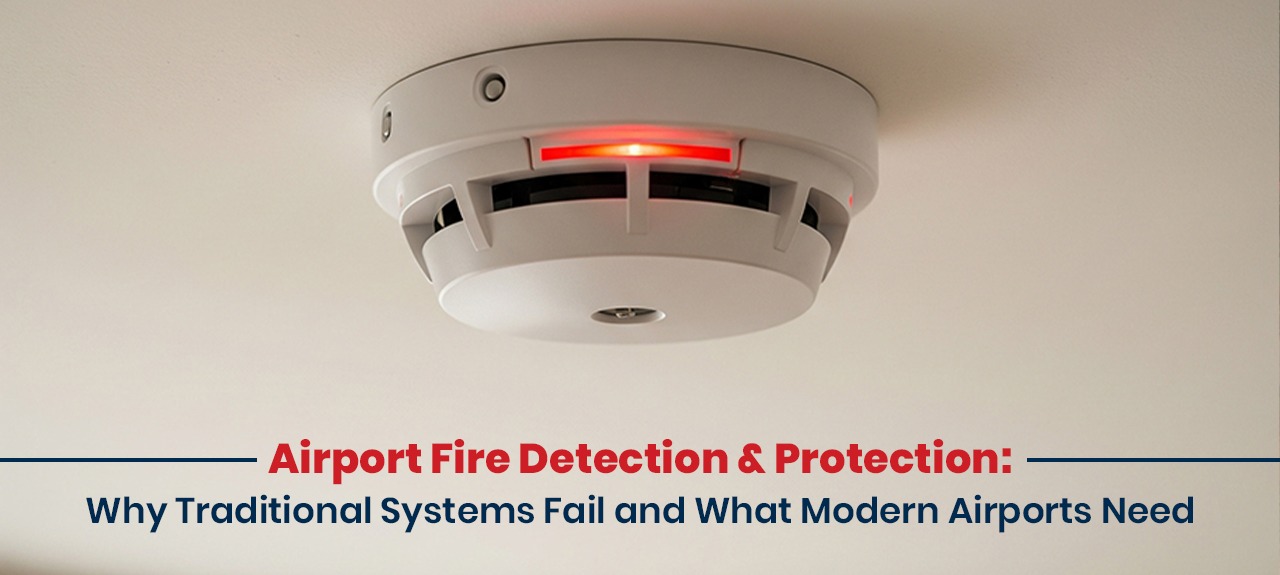
Executive Summary
Fire detection and protection in airports has too often been treated as a compliance item rather than an operational strategy. Many legacy systems were designed for static buildings with predictable occupancy not for dynamic aviation environments where fuel loads shift hourly, passenger density changes by the minute and critical infrastructure runs 24/7. As airports expand terminals, automate baggage systems, add data-heavy operations and integrate new energy sources, the limitations of conventional fire detection and suppression become increasingly visible. This article explains why traditional airport fire systems fail under modern operating conditions and what a contemporary fire safety strategy must include to protect lives, assets and operational continuity.
Modern airports are no longer simple transport hubs. They are complex infrastructure ecosystems combining airside operations, terminals, retail, kitchens, warehouses, data rooms, utilities and high-density people movement. Fire risk has increased and become more variable due to:
Traditional detection and suppression architectures were not engineered for this level of variability. Fixed thresholds and basic detection logic struggle to adapt to changing airflow, occupancy and environmental conditions across terminals, piers, baggage halls and technical zones.
Legacy airport fire protection systems often fail for structural reasons not isolated component defects.
Conventional point smoke detectors are prone to nuisance alarms in high-ceiling terminals, baggage halls, airside zones and plant rooms where dust, exhaust, humidity, temperature swings and airflow turbulence are common. Repeated false alarms “normalize” alerts, conditioning teams to treat alarms as disruptions rather than potential emergencies slowing response when real incidents occur.
Heat-based systems and basic smoke detection may only activate after a fire has developed significantly. In BHS zones, cable tunnels, technical rooms and electrical closets, delay can determine whether the event is contained locally or escalates into a terminal-wide shutdown.
Fire alarm, suppression, building management, smoke control, security and the airport operations center often function independently. That fragmentation delays coordinated action—such as targeted evacuation, airflow and smoke control, selective equipment shutdown and precise isolation of affected zones exactly when time matters most.
Legacy suppression choices can be poorly aligned with today’s risk profile. Water-based systems may cause major collateral damage to sensitive electronics and operational technology, while being less effective against certain electrical and battery-related events unless designed specifically for those hazards and enclosures.
When fire systems underperform whether through repeated false alarms or delayed detection the consequences extend well beyond life safety:
A single false alarm during peak hours can disrupt thousands of passengers across multiple carriers. A real fire without early detection can halt operations for days. Fire protection performance is therefore directly linked to airport resilience, capacity protection and commercial outcomes.
Many airports operate systems that meet code requirements on paper while falling short in operational reality. Standards typically set minimum thresholds, not optimal performance for complex, high-variability environments. Compliance-first designs can become checkbox implementations where adaptability, intelligence, integration and operational decision support are secondary.
Modern airport fire strategy must move beyond compliance toward risk-based design:
Protection should be prioritized accordingly not distributed uniformly by floor area alone.
A contemporary airport fire detection and protection framework rests on five principles:
Use technologies that identify incipient fire signatures before open flame or dense smoke. Aspirating smoke detection and multi-criteria sensing (smoke/heat/CO, etc.) can improve performance in high-airflow environments such as terminals and baggage halls and reduce nuisance triggers when properly engineered and commissioned.
Different hazards require different suppression strategies:
Fire systems should integrate with BMS, smoke control, security platforms, access control and operational databases. Integration enables automated, scenario-based actions such as:
Central dashboards that show device health, alarm confidence levels, zone status and trends allow teams to shift from reactive response to proactive risk management. Analytics can detect detector drift, recurring nuisance patterns, failing components and hidden vulnerabilities before they become incidents.
Fire protection must be managed as a lifecycle program, not a one-time installation. Continuous testing, digital records, performance audits and periodic revalidation ensure the system evolves with terminal expansions, tenancy changes, airflow modifications and new energy loads.
Airport fire detection and protection can no longer be treated as passive safety infrastructure. Traditional systems often fail because they were designed for a different era with different hazards and simpler operating models. Modern airports need intelligent, integrated and risk-driven fire strategies that match the complexity of aviation operations. When fire safety is embedded into operational design, airports gain not only stronger protection but also improved resilience, trust and long-term value.
“Outdated fire detection fails in airports because it was designed for compartmentalised buildings, not sprawling terminals with dynamic airflows and mixed-use spaces. These systems often generate false alarms or miss early fire signatures entirely. Modern airport fire strategies demand integrated detection ecosystems that combine multi-criteria sensors, air-sampling technology and centralized analytics.”
- Roy Sebastian, CEO of GEMS
To discuss integrated fire detection and protection frameworks aligned with modern airport risk profiles:
Rohitkumar.Singh@gmrgroup.in | +91 97171 99753