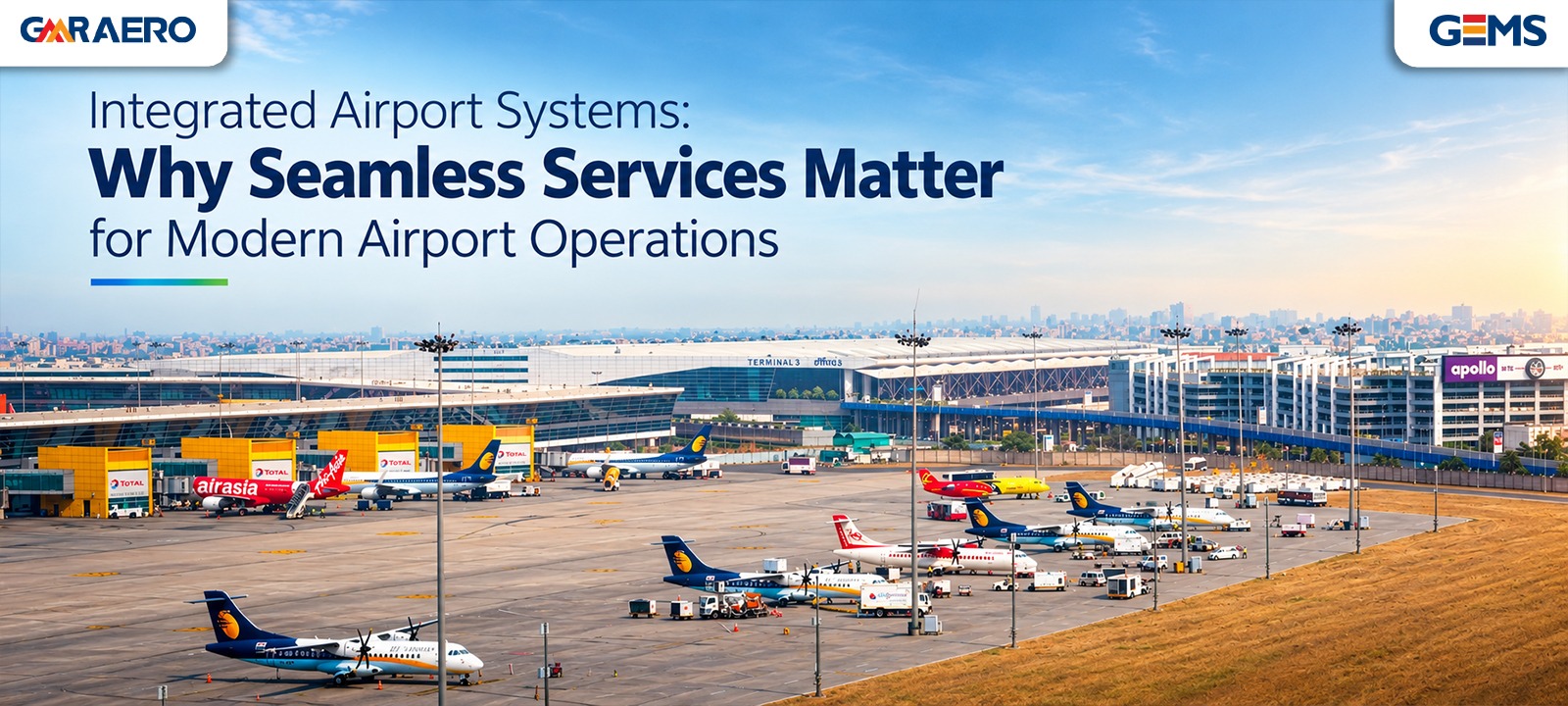
Most passengers never think about what sits behind their journey. They check in, drop a bag, walk to the gate and board. Behind that easy hour, conveyors, sorters, boarding bridges, chillers and switchboards are all running at once and nobody notices them unless one stops.
That is the argument for integrated airport systems. A terminal may look like a set of separate assets, but it behaves like a single machine. A slow belt holds up a departure, a late departure ties up a stand and a busy stand crowds the gate lounge. The services that keep an airport running have to be planned with that chain in mind.
Airport operations seldom break down all at once. Problems build quietly: a baggage belt slowing during the morning peak, a passenger boarding bridge (PBB) that isn’t ready when the aircraft reaches the stand, an air-conditioning fault in a crowded departure hall. None of these is a crisis by itself. Put three of them in the same hour, though and turnaround times start to slip. Passengers notice and so do the airlines.
The airports that cope best stop treating these as separate maintenance contracts. They manage airport systems services as one connected job, with one view of what is happening across the terminal.
Bags are where passengers judge an airport most directly. Conveyors, sorters, screening interfaces and reclaim belts have to stay in step and peak hours are when any weakness shows. Regular preventive maintenance and quick fault response keep turnarounds on schedule and stop a delayed bag from becoming the story of someone’s trip.
The PBB is the passenger’s first and last step between aircraft and terminal. It has to be available, safe and correctly positioned for every arrival. That depends on disciplined maintenance and on the bridge team talking to airside operations before the aircraft is on approach rather than after it has parked.
Mechanical, electrical and plumbing systems only get attention when they fail. HVAC, power distribution, lighting, fire safety, water supply and drainage sit underneath everything else in the terminal. When one of them falters, the baggage hall, the gates and the bridges all feel it.
Engineers look after baggage, bridges and building services as separate specialisms. Passengers don’t. To them, a quick check-in, a cool terminal, a bridge that’s ready and a bag that turns up on the belt all add up to one impression of the airport.
That makes passenger flow a good test of whether systems are actually integrated. When maintenance, operations and engineering teams share information and agree on priorities, problems get caught earlier and fixed faster. Many never reach the passenger at all.
In an airport, reactive maintenance is expensive because every hour of downtime lands on the operation straight away. A planned approach usually includes:
This is what integrated airport operations look like in practice. The goal is fewer surprises on a busy day and quicker recovery when something does fail. Over time, it also means equipment that lasts longer.
Indian airports are expanding terminals, adding capacity and raising the bar on service. Every new gate, belt and plant room is one more system to look after and managing them in silos gets more expensive as the estate grows. A single, coordinated approach to airport systems services gives operators a clearer view of their assets and clearer ownership when something goes wrong. Passengers get a terminal that simply works.
“Airport systems are often judged by what passengers don’t notice: bags that arrive on time, bridges that are ready when the aircraft is and terminals that stay comfortable through the busiest hours. That kind of reliability comes from planning, coordination and maintenance discipline across every system, not from any one of them alone.”
— Roy Sebastian, CEO, GEMS
When integrated airport systems are doing their job, nobody talks about them. Baggage, PBB and MEP services are judged on consistency: performing on the busiest day as well as the quietest, recovering quickly and keeping people moving.
As Indian airports grow in size and complexity, maintenance and operations can’t be planned separately any more. Preventive planning, data-led monitoring and a shared view of passenger flow will do more for an airport’s resilience than any single piece of equipment.
For integrated airport systems services, including baggage handling, PBB and MEP maintenance and integrated airport operations support, contact:
Email: Rohitkumar.Singh@gmrgroup.in
Phone: +91 97171 99753