

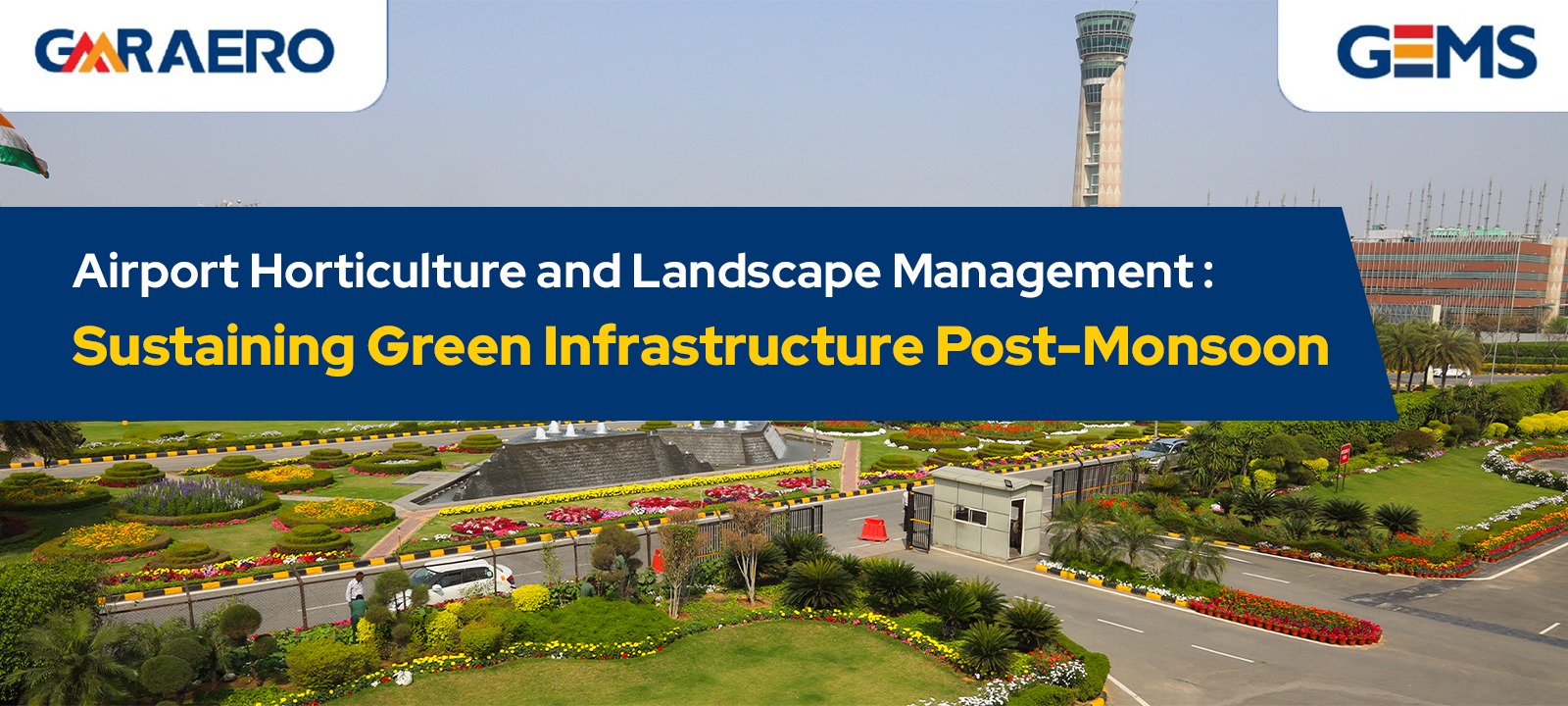
Airports are large, regulated environments where every surface, system and open space is engineered and managed for safety, efficiency and passenger experience. Landscape and horticulture assets, including airside buffer zones, terminal frontages, median plantations, stormwater-linked green belts and ornamental gardens, are as much a part of this engineered environment as runways and terminals.
The monsoon season can place unique stress on airport green infrastructure. Waterlogging, soil erosion, weed proliferation, pest outbreaks and vegetative overgrowth near critical zones can emerge in the weeks following heavy rainfall. If not managed properly, these issues not only impact gardens and lawns but can affect drainage performance, airside safety clearances, wildlife hazard management and the overall visual standard expected of a modern airport.
With airports scaling up and seeking stronger environmental credentials, horticulture and landscape management must evolve from a purely aesthetic function to a proactive, well-planned operational discipline which enhances safety, supports drainage and reinforces airport environmental commitments.
Unlike a commercial park or corporate campus, airport landscapes exist within a tightly regulated operational envelope. Airside greenery, terminal facing gardens, access road plantations and peripheral green belts all interact with safety, drainage and wildlife management requirements.
The challenge is not only to keep an airport looking well maintained. It is to ensure that green infrastructure maintains:
This makes airport horticulture management a contributor to safety, environmental performance and passenger perception not a peripheral maintenance task.
A resilient landscape management programme is designed to recover quickly once monsoon conditions ease.
Airport green infrastructure typically spans multiple zones, including airside safety areas, terminal forecourts, internal roadways, stormwater channels and peripheral plantations. Post-monsoon recovery planning will focus on:
Not every green zone can be treated identically after the monsoon. A structured assessment will identify waterlogged patches, eroded slopes, damaged turf, fallen or weakened trees and areas of fungal or pest infestation so that recovery effort is prioritised where it matters most.
Airport landscapes and stormwater systems are closely linked. Green infrastructure such as swales, buffer plantations and permeable ground cover must be inspected and restored to continue supporting drainage performance.
Rapid post-monsoon growth can compromise airside clearance requirements. Mowing cycles, pruning schedules and growth-control measures must be intensified during this period to maintain compliance with aviation safety standards.
As terminal footprints and landside infrastructure expand, the scale of green infrastructure for seasonal management will grow with them. Landscape programmes must be designed to accommodate this growth without a decline in standards.
At an airport, monsoon damage to soil and turf must not lead to a long-term decline in green cover or drainage performance.
Restoration measures such as soil aeration, re-turfing, erosion control and replanting provide continuity for landscape health once waterlogging recedes. Soil treatment addresses compaction and nutrient loss caused by prolonged saturation, while turf restoration rebuilds ground cover that supports both aesthetics and surface water absorption.
The effectiveness of post-monsoon restoration depends not only on the initial intervention but also on:
Restoration work creates value only when it is followed through consistently, rather than being a one-time seasonal task.
Green infrastructure reliability and airport safety are closely linked.
Airport landscaping supports critical operational requirements, including wildlife hazard management, airside clearance compliance, stormwater drainage and unobstructed sightlines around taxiways and access roads. Poor post-monsoon management can introduce risks such as:
Landscape and horticulture management must therefore be treated as a continuous operational discipline, not as a seasonal or cosmetic requirement. Regular inspections, structured pruning schedules, soil monitoring and pest surveillance help identify emerging issues before they impact safety or drainage performance.
Traditional grounds maintenance often relies on fixed schedules and manual walk-throughs. Modern airport landscape management benefits from more structured data-led oversight.
Systematic monitoring can help grounds and engineering teams track parameters such as soil moisture and drainage performance, turf and plant health across zones, vegetation height near airside clearance areas, pest and disease incidence, irrigation efficiency, tree health and wildlife activity in green zones. When combined with broader asset and facilities management systems, these data help teams identify problem areas, prioritise interventions and shift from reactive clean-up to planned, condition-based landscape maintenance.
Reliable airport landscape management is about more than the extent of green cover on site. Modern airports increasingly use landscaping as part of their stormwater strategy, wildlife management approach and sustainability positioning, all of which depend on the health and appropriateness of the vegetation used, and not just its coverage area.
Poorly maintained or inappropriate green cover can result in:
Species selection, planting density and health monitoring are therefore essential parts of airport horticulture management, particularly for zones that interact with drainage and safety systems.
Airport landscape management must also achieve a balance of strong, healthy green cover without excessive water consumption or maintenance demands.
Airports operate continuously, while irrigation and maintenance needs vary significantly with season, rainfall patterns, terminal activity and land-use changes. Intelligent landscape and water management can help identify:
GEMS's approach to airport horticulture management focuses on monitoring, seasonal planning and integration with broader stormwater and sustainability strategies, rather than treating green infrastructure as an isolated aesthetic function.
Airport landscapes, like electrical and mechanical infrastructure, have long lifecycles and must be planned with future conditions in mind. Future-ready airport landscape management should consider:
The objective is not simply to restore landscapes after each monsoon, but to build green infrastructure that is progressively more resilient to seasonal extremes.
The GEMS Approach to Airport Horticulture And Landscape Management
At GEMS, landscape and horticulture management is viewed as an integral part of the wider airport ecosystem, not as a standalone grounds-keeping function. Effective green infrastructure management requires close coordination across engineering, drainage and stormwater teams, safety and wildlife management functions, and airport operations stakeholders. A holistic approach enables airport operators to move away from reactive post-monsoon clean-up and towards continuously improving the resilience, safety alignment and sustainability performance of their green infrastructure.
From post-monsoon restoration and vegetation control to soil health, irrigation and long-term landscape planning, integrated horticulture and landscape expertise helps airports maintain green infrastructure that supports safe, sustainable and visually consistent operations.
“Airport green infrastructure is often seen as purely aesthetic, but it plays a direct role in drainage performance, wildlife safety and an airport's sustainability commitments. A well-managed landscape, especially through the demanding post-monsoon period, reflects the same discipline and planning that goes into any other critical airport system.”
— Roy Sebastian, CEO, GEMS
Airport horticulture and landscape management rarely receives attention when everything is working as intended, and that is precisely the point. The true measure of green infrastructure management is its ability to recover quickly and perform reliably after seasonal stress, particularly through the demanding post-monsoon period, while continuing to support drainage, safety and sustainability goals.
With airports in India expanding and strengthening their environmental commitments, horticulture and landscape management must evolve along with other critical infrastructure disciplines. Structured post-monsoon recovery, soil and turf restoration, vegetation control near critical zones, data-led monitoring and future-ready species and irrigation planning will increasingly define the resilience of airport green infrastructure.
For integrated Airport Engineering Services, Horticulture and Landscape Management, Stormwater-Linked Green Infrastructure and Sustainability Advisory, please contact:
Email: Rohitkumar.Singh@gmrgroup.in
Phone: +91 97171 99753